
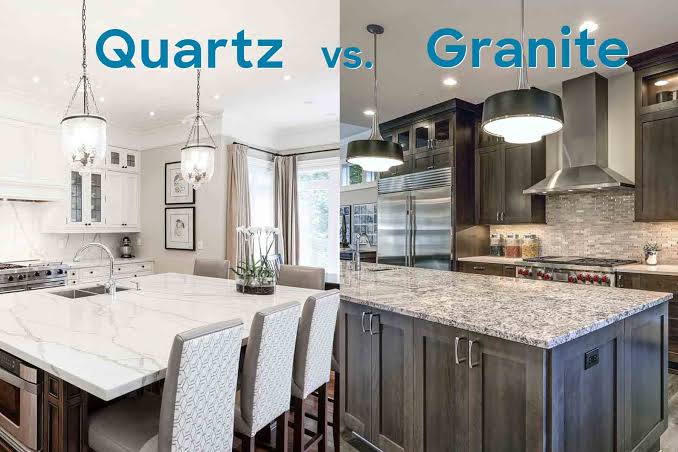
Choosing countertops can feel like picking a spouse. They’re going to be with you for a long time, you’ll interact with them every single day, and the decision is expensive to change. Two of the most popular options are granite and quartz, and people often struggle to choose between them.
Both are beautiful and durable. But they’re different in important ways. Let’s compare them honestly.
What are they?
Granite is natural stone cut from quarries. Each slab is unique, with its own colors and patterns formed over millions of years.
Quartz is an engineered stone made from crushed natural quartz mixed with resins and pigments. Because it’s manufactured, colors and patterns are consistent and wide-ranging.
Appearance
Granite offers a natural, one-of-a-kind look with depth, speckles and veining. No two slabs are the same, which is part of the charm. Quartz offers uniformity and an enormous range of colors, including solid whites, soft grays and designs that mimic marble. If you want a very specific, consistent look, quartz is easier. If you love natural variation, granite shines.
Durability
Both are tough. Granite is extremely hard and resists scratches. Quartz is also scratch-resistant and non-porous, so it resists chips and stains well. Granite can chip on edges if hit hard, though it can often be repaired. Quartz can chip too, and repairs may be more visible.
Heat resistance
Granite handles heat very well, and a hot pan won’t usually damage it, although placing hot cookware straight from the stove isn’t recommended for any surface. Quartz contains resins that can discolor or crack under high heat, so always use trivets and hot pads.
Staining and maintenance
Granite is porous and needs to be sealed periodically, usually once a year, depending on the stone and sealer. Without sealing, liquids like wine, oil and juice can seep in and stain. Quartz is non-porous and doesn’t need sealing, which makes it very low maintenance. For daily cleaning, mild soap and water work for both.
Cost
Prices vary by color, thickness, edge profile and region. Generally, both fall in a similar range, with entry-level granite often cheaper than quartz and premium or exotic granite costing more. Installation, edges, cutouts and removal of old counters affect the total. Always get quotes for the actual project.
Sustainability and health
Granite is a natural material but requires quarrying and transport. Quartz uses resins and manufacturing processes. Both generate dust when cut, and fabricators should follow safety protocols to protect workers. Ask suppliers about sourcing and certifications if this is important to you.
Resale value
Both are seen as upgrades by buyers. Trends move, and quartz has been very popular recently, but granite remains a classic. Neutral colors tend to have wider appeal.
Outdoor use
Granite is better for outdoor kitchens because it handles sun and temperature changes well. Quartz can fade or warp when exposed to strong UV and heat.
Quick comparison
Choose granite if:
- You love unique natural patterns
- You want excellent heat tolerance
- You don’t mind annual sealing
- You might use it outdoors
Choose quartz if:
- You want low maintenance
- You prefer consistent color and pattern
- You want a non-porous surface that resists stains
- You’re willing to use trivets
Tips before you buy
- See full slabs in person, not just small samples, especially for granite.
- Ask about the warranty and what it covers.
- Check the fabricator’s reputation. Installation quality matters as much as the material.
- Plan the seams so they’re placed in a smart location.
- Compare edge styles and thickness, which affect both looks and cost.
Final thoughts
There’s no wrong answer, only the right choice for how you live. If you want a natural, heat-friendly surface and don’t mind some upkeep, granite is a great choice. If you prefer a clean, uniform look with minimal care, quartz is hard to beat. Visit a showroom, touch the samples and imagine your daily routine.