
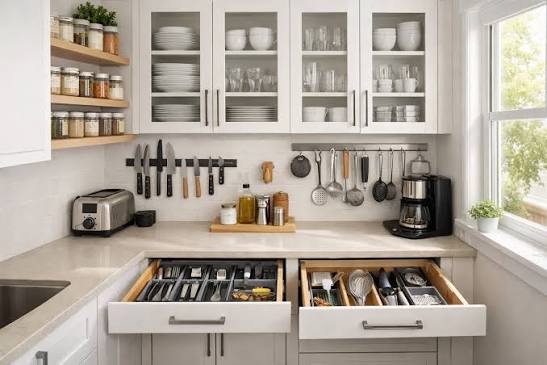
A small kitchen has its charms, but it also has a way of testing your patience. You open a cabinet and a lid falls on your foot. You can never find the right pan. The spice jar you need is hiding behind three others. It feels like you need a bigger kitchen.
You probably don’t. Most small kitchens just need a better system. Here’s how to get more out of the cabinets you already have.
Step 1: Empty and edit
Start with one cabinet at a time so you don’t create chaos. Take everything out, wipe the shelves and sort items into piles: keep, donate and toss. Be honest. Do you really need three spatulas that are melted at the edges, or a waffle maker you haven’t used in two years?
Ask yourself:
- Do I use this at least a few times a year?
- Is it damaged or missing parts?
- Do I have duplicates?
Less stuff means more space and faster cooking.
Step 2: Group items by use
Store things where you use them. Keep pots, pans and cooking utensils near the stove. Put plates, glasses and mugs near the dishwasher or sink. Keep baking supplies together. Store food storage containers in one easy-to-reach spot. The goal is to take as few steps as possible.
Place your most-used items at eye to waist level, and put rarely used ones on high or low shelves.
Step 3: Use vertical space
Most cabinets waste the air above items. Fix that with:
- Shelf risers that let you stack plates or mugs on two levels
- Stackable shelves for cans and jars
- Over-the-door racks for foil, wraps and cleaning supplies
- Hooks inside the cabinet door for measuring cups or pot holders
- Tension rods to turn a cabinet into a vertical storage area for baking sheets and cutting boards
Step 4: Tame the pots and pans
Pots and pans are the biggest troublemakers. Try these tricks:
- Use file organizers or tension rods to store lids and cookie sheets upright.
- Store pans with felt separators or paper towels between them to prevent scratches.
- Hang frequently used pans on a wall rack or a rail on the side of a cabinet.
- Choose nesting cookware if you’re buying new.
Step 5: Pull-outs and lazy Susans
Deep, hard-to-reach cabinets are where things go to be forgotten. Install pull-out shelves or sliding drawers so you can see everything at a glance. Use a lazy Susan, a rotating tray, for corner cabinets and for oils, sauces and spices. Many are affordable and don’t require installation.
Step 6: Make spices simple
Spices can take over a cabinet. Use matching jars, label the lids and arrange them alphabetically or by cuisine. A tiered spice rack or a drawer insert lets you see every jar. If cabinet space is tight, a magnetic strip or a narrow rack on the wall can hold small tins.
Step 7: Use bins and baskets
Containers create instant order. Use clear bins for snacks, packets and small items. Use baskets for potatoes, onions or produce that doesn’t need refrigeration. Label them so everyone in the household knows where things belong.
Step 8: Don’t ignore the walls and doors
If cabinets are full, expand outward. Add a magnetic knife strip, a rail with hooks for utensils, or open shelves for items you use daily. A rolling cart in a gap can offer extra storage and a work surface.
Step 9: Keep safety in mind
Store heavy items low so you don’t have to lift them overhead. Keep sharp knives away from the reach of small children, and store household cleaners separately from food. If you rent, check with your landlord before drilling or installing permanent fixtures.
Step 10: Maintain the system
Organization only lasts if it’s easy. Do a quick reset once a week and do a larger cleanup each season. If something doesn’t have a home, decide whether it really belongs in your kitchen.
Final thoughts
You can make a small kitchen feel bigger without spending a fortune. Edit what you own, use vertical space, and give every item a spot. Soon, cooking will feel less like a scavenger hunt and more like a pleasure.