
Picture this: you’re at a garage sale, eyeing a gorgeous dresser with a price tag that feels a little too good. The seller says, “It’s real wood.” But is it solid wood, or just a thin wood skin glued onto something cheaper?
Knowing the difference can help you spot a bargain, avoid an overpriced piece and decide whether something is worth refinishing. Here are easy ways to tell.
First, what’s the difference?
Solid wood means the piece is made of natural lumber all the way through. Oak, maple, walnut, cherry and pine are common examples.
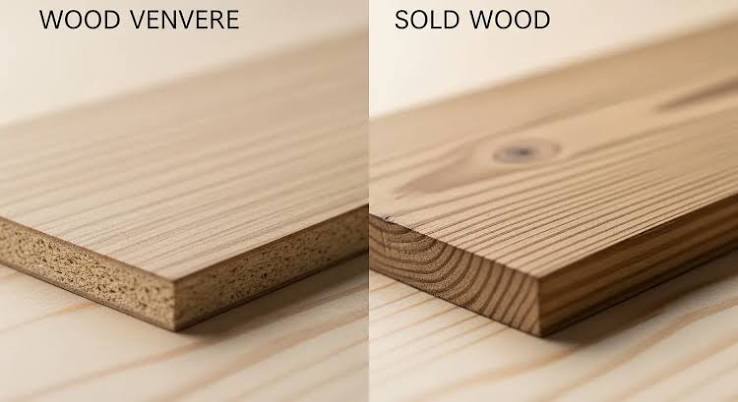
Veneer is a thin layer of real wood, often just a millimeter or so, glued over a core of plywood, particleboard or MDF.
Veneer isn’t automatically bad. Many beautiful antiques and high-end pieces use veneer. It can be more stable than solid wood and less prone to warping. The key is knowing what you’re buying so the price matches.
Test 1: Look at the edges
Check the edges of tabletops, drawer fronts and shelves. On solid wood, the grain pattern on the top continues around the edge. On veneer, you may see a thin line where the layer ends, or the edge may look different from the top, like a stripe of banding.
Test 2: Check the grain pattern
Solid wood has natural, irregular grain that doesn’t repeat. If you see identical patterns repeating across a surface, or a pattern that looks printed, it could be a laminate or photo veneer. Also look for grain that doesn’t line up where two panels meet.
Test 3: Look underneath and inside
Flip a drawer or peek at the back of a dresser. Raw, unfinished surfaces tell the truth. Solid wood shows consistent grain through the piece. Particleboard looks like compressed sawdust with tiny flecks, while plywood shows thin layered strips along the edge.
Test 4: Pay attention to weight
Solid wood is generally heavy. If a large dresser feels surprisingly light, it may be made from engineered wood. This isn’t foolproof, since some solid woods like pine are light, but it’s a helpful clue.
Test 5: Check the joinery
High-quality solid wood furniture often uses dovetail joints, mortise-and-tenon joints or dowels. Staples, visible glue, cam locks and cardboard backing point toward lower-grade construction. Drawers with dovetailed corners are usually a good sign.
Test 6: Knock and listen
Tap on the surface. Solid wood gives a deeper, fuller sound, while particleboard or hollow-core panels sound dull or hollow. Again, it’s not a perfect test, but it adds to the picture.
Test 7: Look for damage
Chips, peeling or bubbling often reveal what’s below. If you see a pale, crumbly material under a damaged spot, the piece is likely engineered wood with a veneer. Water damage tends to swell particleboard dramatically.
Misleading labels to watch for
Some sellers use wording that sounds impressive but isn’t very specific:
- “Wood finish” or “wood look” often means imitation.
- “Genuine wood veneers” means veneer, not solid.
- “Made with solid wood” might only refer to certain parts, such as the legs.
- “Engineered wood” is a manufactured composite.
In many places, products sold with misleading claims can violate consumer protection rules. If a seller states something is solid wood and it isn’t, keep your receipt and ask for a refund or exchange.
Is veneer okay for you?
Veneer can be a smart choice if you want a lighter, more affordable piece with a consistent look. Solid wood is better if you want something you can sand and refinish repeatedly, or something that will last for decades. Thick veneer can sometimes be lightly refinished, but thin veneer can sand through easily.
Pricing guide
If a large piece is priced very low, ask questions. Solid wood costs more because of the material and the craftsmanship. A reasonable price should reflect what the piece is made of.
The takeaway
Look at the edges, check the back and drawers, feel the weight and test the joints. Combined, these clues will tell you what you’re really holding. Whether you choose solid wood or veneer, the goal is knowing what you’re paying for.